
Shungite Stone – The Ancient Carbon Mineral from Karelia
The shungite stone is one of the most fascinating natural carbon materials found on Earth. Found almost exclusively in the northern Russian region of Karelia, this deep black mineral formed nearly two billion years ago during the Precambrian era. Its rich carbon composition and mysterious internal structure have long captured the interest of both scientists and collectors. With its distinctive dark sheen and ancient origin, shungite is often seen as a bridge between geology, history, and the natural world.
Over the centuries, shungite has earned a reputation that reaches far beyond scientific circles. It is admired not only as a geological wonder but also as a stone symbolizing purification, stability, and energetic harmony. Today, it stands at the crossroads of scientific curiosity and traditional wisdom—an ancient material that continues to inspire study, reflection, and everyday use in modern life.
What Is Shungite?
Shungite is a naturally occurring mineraloid composed primarily of carbon. Unlike most minerals, it does not possess a defined crystalline structure. For this reason, shungite is classified as a mineraloid rather than a true mineral species and is not officially recognised as a mineral by the International Mineralogical Association (IMA).
The carbon content of shungite stone varies depending on the geological grade. Some varieties contain roughly 30% carbon, while rare forms known as Elite Shungite may contain more than 90% carbon.
Basic Physical Properties of Shungite
- Chemical Formula: C (carbon)
- Colour: Dark grey to deep black
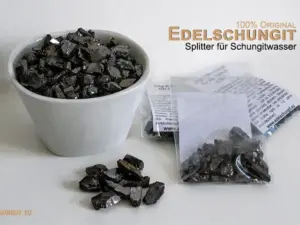
- Appearance: Coal-like rock with matte or metallic luster
- Hardness: Variable
- Crystal System: Non-crystalline (amorphous)
- Primary Origin: Karelia Republic, Russia
The name shungite originates from the village of Shun’ga near Lake Onega, where the material was first described scientifically in 1879.
Geological Origin of Shungite Stone
The only known significant deposits of shungite stone are located in the Karelia Republic of Russia. These formations are among the oldest carbon-rich rocks on Earth, dating back roughly two billion years.
Most shungite used today comes from the Zazhoginsky deposit, a large geological formation near Lake Onega. Because the stone occurs almost exclusively in this region, authentic shungite is closely linked to its Russian geological origin.
Types of Shungite Stone
Shungite is commonly classified into several types depending on its carbon concentration.
| Type | Carbon Content | Appearance |
|---|---|---|
| Elite / Noble Shungite (Type I) | 75–98% | Silvery black with metallic luster |
| Shungite Type II | 35–74% | Matte black stone |
| Shungite Type III | 20–34% | Dark grey rock |
The rare Elite Shungite variety is particularly valued because of its high carbon concentration and characteristic metallic appearance.
Explore authentic shungite stones and products here:
– Learn more about Type I Shungite
-

-
Angebot!

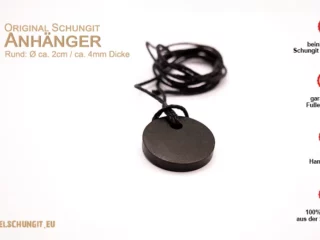
Schungit Anhänger 2 cm – Schutz & Wohlbefinden
Ursprünglicher Preis war: 10,00 €8,90 €Aktueller Preis ist: 8,90 €. In den Warenkorb -
Angebot!
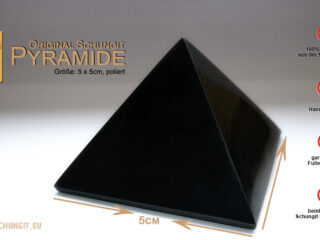
Schungit Pyramide 5 x 5cm (poliert)
Ursprünglicher Preis war: 21,90 €19,90 €Aktueller Preis ist: 19,90 €. In den Warenkorb
Shungite Stone in Scientific Research
Due to its exceptionally high carbon content, the shungite stone has attracted interest in modern material science. Researchers have studied the microscopic structure of shungite and its unique carbon composition.
Laboratory studies have investigated the structural characteristics of shungite, including the presence of carbon formations that resemble fullerenes — spherical carbon molecules first identified in scientific research during the 1980s. These molecular structures are notable for their stability and distinctive arrangement of carbon atoms.
Additional investigations have explored how carbon-rich materials such as shungite stone interact with electromagnetic fields (EMF) and how their molecular structure behaves under laboratory conditions. Some studies also examine antioxidative properties of certain carbon configurations.
Examples of scientific publications discussing structural aspects of shungite include:
- DOI: 10.1016/j.cap.2021.06.008
- DOI: 10.1021/acsomega.8b01584
Further information about scientific publications and research related to shungite can be found on our knowledge platform: Shungite Studies and Research Overview
These studies focus on the physical and chemical properties of carbon materials found in shungite. They describe laboratory observations related to the structure of the material and do not represent medical claims or verified health effects.
Traditional and Cultural Uses of Shungite
Historically, shungite stone has been used in Russia since at least the 18th century. Historical accounts describe its use in connection with water purification. It is often mentioned that Peter the Great encouraged the use of shungite in water sources used by his army.
In modern times, shungite is also associated with holistic traditions. Within these traditions, the stone is often symbolically linked to grounding, energetic balance, and environmental harmony.
- Association with the Root Chakra
- Symbolic connection to the Earth element
- Use in living spaces for energetic grounding
- Placement near electronic devices in modern spiritual practices
Many people choose to wear shungite jewellery or place decorative objects such as pyramids, spheres, or cubes made from shungite in their homes.
Video: Understanding Shungite
The following video presents an overview of the characteristics and traditional uses often associated with shungite stone:

How to Identify Authentic Shungite
Because genuine shungite stone contains a significant percentage of carbon, it is slightly electrically conductive. This property is sometimes used as a simple method for verifying authenticity.
- Natural irregular surface texture
- Deep black coloration ranging from matte to metallic
- Geological origin from the Karelia region
- Higher conductivity in high-carbon varieties
Frequently Asked Questions About Shungite Stone
Where does shungite come from?
Shungite originates almost exclusively from the Karelia Republic in Russia, particularly near Lake Onega and the village of Shun’ga.
Is shungite a crystal?
No. Shungite is classified as a mineraloid because it lacks a defined crystalline structure.
What is shungite stone used for?
Shungite is commonly used for mineral collections, jewellery, decorative objects, and traditional cultural practices.
Why is Elite Shungite considered rare?
Elite Shungite contains an exceptionally high carbon concentration and occurs in much smaller quantities compared to other shungite types.
Disclaimer
The information provided here describes geological characteristics and traditional cultural associations of shungite stone. The content is intended for educational purposes only and does not represent medical advice or scientifically proven health effects. Hinweis des Autors: Relevante wissenschaftliche Informationen und Einordnungen finden Sie auf meiner zentralen Übersichtsseite: Schungit Lexikon – zentrale Informationen .
Schungit Experte (Erfahrung seit 2003), Fachautor, Buchautor und Betreiber von Edelschungit.eu (Erfahrung und Zertifizierungen bei CPD, CMA, IPHM).
Weitere Informationen finden Sie auf der Über mich – About me Seite.